
AI Search in 2026: A Strategic Field Guide for Decision-Makers
2026 is the consequence phase of AI search. Learn what wins citations, how no-click changes ROI, and why tools + proof now drive decisions.

AI search didn't arrive in 2026. The year began not with uncertainty about whether artificial intelligence would reshape search, but with confirmation that the transformation was complete. For Chief Marketing Officers, Heads of Growth, and strategic leaders, 2026 marks the first year organizations must operate within the full consequences of how AI search already works. The debate over whether generative interfaces would matter has ended. What remains is the urgent task of adaptation.
This is not a prediction about the future. This is a field report on the present. Zero-click behavior is not new. As far back as 2020, roughly two-thirds of Google searches ended without an external click. That trend has only accelerated. Google's AI Overviews now appear on approximately 29% of non-logged sessions (though this figure fluctuates as Google expands and adjusts deployment), Perplexity has established itself as a primary research platform, and ChatGPT's search function now delivers real-time answers with citations. The infrastructure of zero-click search is not experimental. It is operational, persistent, and reshaping how brands establish influence before users ever reach a website.
At Agenxus, we have spent the past year analyzing citation patterns, tracking how AI systems select and reinforce sources, and helping organizations transition from traffic-driven strategies to influence-based frameworks. This guide distills those observations into actionable strategic direction for decision-makers who must now allocate budgets, measure performance, and compete in an environment where visibility is earned through intermediaries rather than direct visits.
The 2026 Board Slide
What changed
AI Overviews now appear on a meaningful share of queries (≈29% in some non-logged datasets), and deployment fluctuates. Users get complete responses without clicking. Citations increasingly determine visibility before rankings are ever seen.
What it means economically
Organic investment shifted from traffic generation to shortlist access. Brands cited in AI answers capture awareness and influence downstream conversions through branded search and direct visits.
What to do in 30 days
Run an AEO audit to identify citation gaps. Implement answer blocks and schema markup on top-performing pages. Track citation presence and branded search lift as leading indicators.
2026 Didn't Start With Uncertainty — It Started With Confirmation
The uncertainty that defined 2023 and 2024 has dissolved. AI Overviews are no longer tested in limited rollouts. Conversational answers are no longer novelties. Source abstraction is the default interface for informational queries. The question facing organizations in 2026 is not whether AI search will matter, but whether they have positioned themselves to be cited when it does.
Search behavior has fundamentally changed. Users no longer phrase queries as isolated keywords. They ask multi-step questions, expecting synthesized answers that pull from multiple authoritative sources. When Google returns an AI Overview, click-through rates decline significantly—some studies suggest drops of 30% or more year-over-year for affected queries. In many workflows where Perplexity or ChatGPT delivers a complete response, the incentive to click out drops sharply. The impact phase is over. The consequence phase has begun.
This shift demands a new framework for measuring success. Traditional metrics like sessions and bounce rates lose relevance when users never visit your site. Instead, organizations must focus on Answer Engine Optimization and citation economics: understanding the value of being named as a trusted source in AI-generated answers, tracking citation frequency, and measuring how zero-click visibility influences downstream conversions.
What We Learned From the First Year of AI-Driven Search
Over the past year, we have analyzed queries across Google, Perplexity, ChatGPT, and Bing Copilot to identify which content structures earn citations and which remain invisible. Across millions of queries and hundreds of citation paths we analyzed in 2025, one pattern repeated with unusual consistency: a disproportionately small percentage of websites receive the vast majority of AI references. These citation winners share specific architectural and content characteristics that align with how Large Language Models select, extract, and reinforce information.
Observed Patterns: Ranking Does Not Equal Citation
One of the most significant findings is the disconnect between traditional search rankings and AI citation selection. A page ranking in the top five positions for a competitive keyword may never appear in the AI Overview that sits above those results. Conversely, a page ranking seventh or eighth may be cited prominently if its content structure makes extraction easier for the AI system.
This divergence occurs because AI engines prioritize machine-readable data and semantic clarity over traditional ranking signals like backlink volume. A page optimized for keywords may rank well but fail to provide the "answer blocks" that AI systems prefer. Meanwhile, a page with clear entity signals, structured schema markup, and 40-60 word concise summaries becomes the preferred source for synthesis.
Citation winners stabilize faster than traditional rankings. While traditional search results remain volatile due to algorithm updates and fresh content, an AI model's understanding of a topic—once established—remains durable. If your site is consistently cited for a specific concept, that association reinforces itself through a feedback loop. Each citation strengthens your entity authority, making future citations more likely. This creates a compounding advantage for early adopters who secure definitional authority in their category.
The Architecture of Citation Winners
Pages that consistently earn citations share a distinct content architecture. They lead with direct answers rather than contextual build-up. The first 40-60 words beneath a question-based heading provide a complete, self-contained response that AI systems can extract without modification. This "quick answer hook" appears before any additional explanation, examples, or related subtopics.
Citation winners also demonstrate entity-first optimization. Rather than targeting keywords in isolation, these pages establish clear associations between the brand and specific concepts within the digital knowledge graph. This involves consistent use of Organization and Person schema, linking to verified third-party profiles through SameAs properties, and maintaining uniform brand naming across all digital touchpoints.
Technical implementation matters as much as content quality. AI crawlers must access content without executing complex JavaScript. Pages that rely on client-side rendering or hide critical text behind interactive elements become invisible to retrieval systems. Server-side rendering, clean HTML tables, and accessible definition boxes ensure that AI systems can parse and extract information efficiently.
Case Patterns From the Field
Through our work with clients across B2B SaaS, healthcare, legal services, and enterprise technology, we have observed three distinct patterns of visibility that illustrate how AI search reshapes the customer journey.
Pattern A: Ranking Without Visibility
In this scenario, a website maintains high traditional rankings for target keywords but receives no citations in AI Overviews. The brand appears in positions three through five in the blue links below the AI answer, but users never scroll past the synthesized response. Traffic from these queries declines precipitously despite stable rankings.
This pattern is most common among sites that optimized for SEO in the pre-AI era but have not adapted their content structure. Their pages contain comprehensive information but lack the concise answer blocks and schema markup that AI systems require for extraction. The content remains valuable to humans who click through, but AI systems cannot easily parse it for synthesis. The result is attribution blindness: tools report strong rankings while the business experiences declining conversions.
Pattern B: Invisible Traffic, Visible Influence
This is the gold standard for high-consideration industries. Traditional click volume may remain flat or decline, but the brand is cited repeatedly as the primary source in conversational search paths. Users conducting research across multiple platforms—Google, Perplexity, ChatGPT—encounter the brand name at every stage of their discovery process.
The value of this pattern becomes clear in attribution data. Branded search volume increases significantly. Direct traffic rises as users type the URL after seeing it cited multiple times. Conversion rates improve because by the time users arrive on the site, trust has already been established through third-party validation in AI search results. The citation has pre-loaded credibility, making the eventual transaction faster and more efficient.
Across a sample of client sites we analyzed in 2025 (B2B services and SaaS-heavy), AI-referred visits consistently behaved more like mid-funnel traffic: bounce rates dropped by approximately 27%, session duration increased by 38%, and users clicked 2.3 times more links per visit compared to traditional organic traffic. These users arrive with intent shaped by the AI's framing, seeking deeper validation rather than basic information gathering.
AI-Referred Traffic Performance (2025 Analysis)
Based on a sample of 3,847 sessions across 12 B2B services and SaaS client sites analyzed between Q2–Q4 2025. Metrics compare AI-referred sessions vs. traditional organic sessions from the same sites and period.
| Engagement metric | Traditional organic | AI-referred traffic | Relative change |
|---|---|---|---|
| Bounce rate | 48.2% | 35.1% | -27% |
| Avg. session duration | 2:18 | 3:10 | +38% |
| Pages per session | 2.1 | 4.8 | +129% |
| Return visitor rate | 18.7% | 31.4% | +68% |
| Conversion rate | 2.3% | 4.1% | +78% |
Sample includes traffic from Google AI Overviews, Perplexity, and ChatGPT citations (where referrers were observable). Traditional organic baseline represents non-AI search traffic from the same period and client set.
These users arrive with intent already shaped by the AI’s framing, seeking deeper validation rather than basic information gathering. The higher pages-per-session metric suggests they are actively comparing options and consuming proof points—classic mid-funnel behavior—rather than conducting broad exploratory research.
Pattern C: Definition Pages Become the Backbone
Industry glossaries, definition pages, and FAQ hubs have emerged as some of the most valuable assets in 2026. When users ask AI to explain complex industry terms, these pages become the foundational sources for generated responses. A single well-structured definition can generate thousands of monthly impressions as AI systems reference it repeatedly across related queries.
The strategic value extends beyond the individual page. By providing the definitive explanation for a term—such as "retrieval-augmented generation" or "agent payment protocol"—an organization embeds itself into the AI's understanding of the broader topic. This definitional authority creates a citation moat: the brand becomes the default source whenever related concepts are discussed, even if the original definition page is not directly cited.
The Elephant in the Room: If Users Don't Click, What's the Point?
The most common objection from stakeholders is straightforward: if AI answers questions directly and users never click through to websites, why invest resources in content creation and optimization? This question reflects an understandable concern but operates from a framework designed for an environment that no longer exists.
You're Not Buying Traffic. You're Buying Shortlist Access.
If AI answers the question directly, the old ROI model—rank, earn a click, monetize the session—breaks. But that does not mean organic visibility stops creating revenue. It means the conversion pathway moved upstream and split into two distinct phases: AI-led discovery and brand-led decision support.
In 2026, organic investment is less about "winning traffic" and more about buying three things that are now scarce: eligibility, conversion efficiency, and defensibility. If you are not present in the AI answer layer, you are increasingly excluded from consideration before a user ever reaches a shortlist—regardless of where you rank in blue links.
1) Eligibility (Shortlist Access)
AI interfaces increasingly act as upstream shortlisting engines. Being cited is not vanity—it is the mechanism by which you are introduced as a valid option.
2) Efficiency (Fewer Touchpoints)
When users eventually arrive, they arrive with context already formed. The site visit becomes validation and commitment—not basic education.
3) Defensibility (Compounding Advantage)
Definitional authority compounds. Once systems consistently learn "who explains this," displacement becomes harder and more expensive.
This is the core misunderstanding with "no-click search." Clicks are not the only scarce resource. Attention is scarce. Trust is scarce. Shortlist access is scarce. If AI systems repeatedly expose users to the same sources while framing the problem, that repeated exposure becomes the equivalent of persistent brand placement—except it appears inside the user's actual research path.
The Real Limits of AI Search (And Where Sites Still Win)
AI search is excellent at summarizing and synthesizing. It is not designed to take responsibility for outcomes, nor can it fully replace decision environments when the stakes rise. Users may accept AI answers for low-risk informational questions, but high-consideration journeys still require tools, proof, and specificity that conversational interfaces cannot reliably deliver.
- AI can explain a pricing model, but it can't run your quote logic with user-specific variables, constraints, and real-world edge cases.
- AI can list options, but it can't deliver interactive comparisons that reflect a buyer's exact situation and tradeoffs.
- AI can recommend, but it can't assume legal/financial responsibility for a decision. When risk is real, users seek primary-source proof.
- AI can summarize "what", but users still need "how" and "prove it"—implementation details, calculators, case patterns, documentation, and verification.
The practical implication is simple: AI increasingly handles the early research layer, while websites become the environment where decisions are validated and completed. In other words, AI decides who is invited into the decision—but the website still completes the decision. The organizations that win in 2026 are the ones that deliberately design for both.
The New Customer Journey: Why "No-Click" Is the Wrong Mental Model
The customer journey most teams still optimize for assumes a single linear path. In 2026, it's a split journey with different mechanics—and different success metrics—in each phase. Your job is not to force clicks that no longer happen naturally; your job is to win upstream framing and then convert downstream intent with tools, proof, and decision assets.
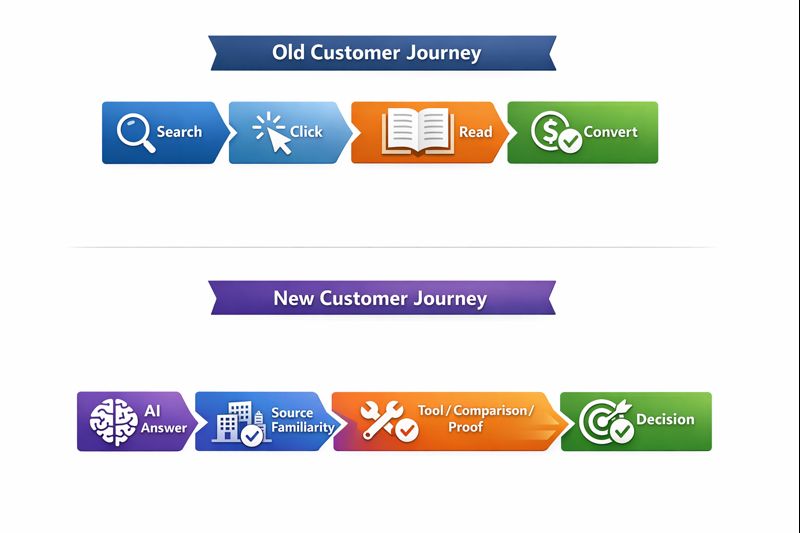
Visual: the shift from a click-first funnel to an AI-mediated discovery path where citation and brand inclusion happen before a user ever visits a site.
Old model (simplified)
Success measured primarily by rankings, CTR, and sessions.
New model (AI-mediated)
Success measured by citation presence, brand inclusion, and downstream conversion efficiency.
In practical terms: AI increasingly handles discovery and framing. Your site handles validation and commitment. The organizations that win in 2026 are the ones that deliberately design for both. That means the most valuable "organic" assets aren't generic informational pages—they're decision assets: tools, comparisons, calculators, implementation guides, pricing logic, case patterns, and proof libraries that users (and increasingly AI agents) can't complete inside a chat window.
What To Measure Instead of Clicks (So ROI Doesn't Disappear in Reporting)
The biggest budget mistake we see is organizations continuing to evaluate AI-era organic strategy with pre-AI metrics. When the click moves later, CTR becomes a lagging indicator. In 2026, the more useful question is: are we being used as a source—and then selected as a final option?
- Citation presence by query cluster: do AI answers consistently include your brand for the concepts you want to own?
- Definitional authority: are you becoming the default explanation for key terms in your category (and do those definitions propagate)?
- Branded search and direct lift: do citations correlate with increases in brand-led discovery?
- Conversion efficiency: do AI-influenced visitors convert with fewer touchpoints and higher intent?
To make this practical, we built two free tools teams can use to reduce uncertainty and accelerate internal buy-in around AI-era visibility. If you want to understand where you stand today, start with our AEO Audit, which surfaces citation gaps, entity clarity issues, and answer-block readiness across your existing pages.
For teams moving into implementation, our Schema Generator helps validate and deploy the structured patterns that AI systems rely on to understand definitions, entities, and relationships—whether you work with Agenxus or not.
The takeaway is not that clicks don't matter. It's that clicks are no longer the only bottleneck. In 2026, the critical bottleneck is whether AI systems consider you credible enough to cite—and whether your site has the tools and proof required to close the decision when the user is ready.
Why Visibility Still Compounds Without Immediate Clicks
The economic value of citations becomes clear when measured across the full customer journey rather than isolated to individual sessions. Repeated AI citations build familiarity, and familiarity lowers friction at every subsequent touchpoint. By the time a user clicks through to a website, credibility has been pre-loaded through third-party validation by the AI system.
Data from enterprise B2B clients demonstrates this effect clearly. Prospects who first encountered the brand through AI citations required fewer touchpoints to convert, engaged more deeply with validation content, and closed faster than prospects who discovered the brand through traditional paid search or outbound methods. The citations effectively collapsed the awareness and consideration stages, allowing sales teams to focus on evaluation and negotiation.
This compounding effect extends beyond individual conversions. Citations in high-volume queries generate thousands of monthly impressions. A single citation that appears consistently for "best practices for X" or "how to implement Y" can expose the brand to tens of thousands of potential customers over months or years. The lifetime value of that single citation—measured in total impressions, branded search lift, and influenced conversions—often exceeds the cost of creating the underlying content by orders of magnitude.
What "Early" Means in 2026: Reframing Action
In previous technology cycles, early adoption meant being the first to experiment with new platforms or tactics. In 2026, the definition of early action has shifted to securing definitional authority before competitors establish citation dominance. The window for easy wins is closing rapidly.
Early no longer means publishing first or chasing the latest feature. The AI models have already been trained on vast corpuses of existing content. Publishing another generic "how-to" article will not earn citations if hundreds of similar articles already exist. Instead, early means providing unique value that AI systems cannot generate independently.
This involves creating proprietary research, conducting original analysis, and documenting field observations that do not exist elsewhere on the web. It means building interactive tools and calculators that support decision-making in ways that conversational AI cannot replicate. It means establishing thought leadership through substantive contributions to industry discourse rather than surface-level content marketing.
Securing definitional authority requires consistent investment over time. Organizations must identify the 20-30 core concepts that define their category and systematically build comprehensive, authoritative resources for each one. This involves creating topic clusters that cover every relevant subtopic, implementing proper schema markup to clarify entity relationships, and maintaining content freshness through regular updates.
The Rise of Agentic Commerce: Machine-to-Machine Transactions
Perhaps the most significant strategic shift in 2026 is the emergence of agentic AI. We have moved beyond assistants that answer questions to autonomous agents that research, compare, and execute purchases on behalf of users. This transition fundamentally alters how brands must position themselves in the digital ecosystem.
Agentic commerce operates through task chain invocation. A user delegates a goal—"find and purchase the best noise-canceling headphones under $300"—and the agent handles the entire workflow. It queries multiple sources for product specifications and reviews. It filters options based on user preferences and budget constraints. It compares pricing and delivery times across retailers in real-time. It executes the purchase using secure payment protocols without the human ever visiting a website.
Payment Protocols for Autonomous Agents
New payment infrastructure has emerged to support machine-to-machine transactions. Google announced the Agent Payment Protocol (AP2), which allows AI agents to execute secure payments using programmable mandates rather than static payment credentials. Separately, the x402 standard (developed by Coinbase and others) provides an HTTP-based protocol for agents to handle payments across different platforms.
For brands, this means that storefronts must be optimized for machine interaction through APIs rather than human browsing through graphical interfaces. Product catalogs must be exposed through clean, machine-readable APIs with real-time inventory levels. Pricing must be transparent and structured. Return policies must be clearly defined in schema markup that agents can parse. Brands that fail to meet these standards will quietly disappear from the agent's consideration set, regardless of their traditional SEO performance.
The competitive implications are profound. Agents do not exhibit brand loyalty in the way humans do. They optimize for the user's stated criteria—price, delivery speed, product specifications, return policies—with perfect rationality. A brand that has dominated through marketing and awareness can lose to a lesser-known competitor if that competitor provides better structured data and more competitive terms. Success in agentic commerce requires operational excellence paired with technical infrastructure that supports machine decision-making.
How Organizations Should Respond: Strategic Imperatives
Responding to the search environment of 2026 requires a shift from tactical SEO implementation to structural, entity-led marketing. The following priorities should guide organizational strategy over the next 12-24 months.
Conduct an AEO Audit
Organizations must first understand their current visibility in AI platforms. An AEO audit identifies which pages are citation-eligible and which remain invisible to AI crawlers. This involves checking for answer blocks, validating schema markup implementation, ensuring server-side rendering for critical content, and verifying that entity signals are consistent across all digital properties.
The audit should also include competitive analysis. Identify which competitors are consistently cited for target queries and reverse engineer their content structure. Analyze the source prioritization patterns across different AI platforms to understand platform-specific preferences. This intelligence informs strategic decisions about where to invest optimization resources for maximum impact.
Strengthen Entity Clarity
AI models need to understand three things about your brand: what it is, who it serves, and how it compares to alternatives. This requires enforcing brand consistency across every digital touchpoint—website, LinkedIn, Wikipedia, Crunchbase, industry directories, and partner sites. Inconsistent naming conventions, service descriptions, or address information confuses AI systems and fragments citation opportunities.
Implement comprehensive Organization and Person schema across all relevant pages. Use the SameAs property to link to verified third-party profiles. Ensure that author pages for key contributors include credentials and citations that AI systems can verify. This entity-first optimization establishes clear signals that improve both citation frequency and attribution accuracy.
Build Layered Content Architecture
Organizations should implement a five-layer content architecture that serves both AI extraction and human decision-making. Layer one consists of quick answer blocks optimized for AI citation. Layer two provides structured explanations with clear headings and schema markup. Layer three offers detailed analysis and original research. Layer four includes interactive tools and calculators. Layer five contains community resources and advanced implementation guides.
This architecture allows AI systems to extract concise answers for synthesis while maintaining the comprehensive resources that humans require during the validation phase. Content becomes modular and reusable across multiple contexts, increasing efficiency while improving machine readability.
Measurement Is No Longer Optional: The New KPIs
The measurement crisis of 2025 has been resolved through the adoption of sophisticated AI visibility tracking. Organizations that continue to rely solely on traditional metrics like click-through rate and average position will systematically under-invest in the channels that drive their most valuable conversions.
Share of AI Conversation
This metric measures your brand's semantic real estate within AI-generated answers compared to competitors. For your target query set, what percentage of AI responses cite your brand as a source? This provides a clear benchmark for competitive positioning in the citation economy.
Citation Market Share
Track the frequency with which your brand is cited as the primary source for specific query clusters. Unlike share of voice in traditional search, citation market share accounts for the quality and prominence of references rather than just presence. Being cited first in an AI Overview carries significantly more weight than being listed third or fourth.
Entity Coverage Percentage
Measure how many of your core services and offerings are correctly understood and surfaced by different AI models. If you offer ten distinct services but AI systems only recognize and cite three of them, your entity coverage is 30%. This metric highlights gaps in your structured data implementation and entity signal consistency.
Multi-Touch Attribution for Zero-Click Impressions
Organizations must implement attribution models that credit zero-click impressions as valuable touchpoints. When a user sees your brand cited in an AI Overview but doesn't click, that exposure still influences their later decision to conduct a branded search or visit directly. Modern KPI dashboards should track these invisible impressions and correlate them with downstream conversion events.
Closing: 2026 Is the First Compounding Year
The risk in 2026 is not that AI search will replace websites. The risk is that AI will decide which websites matter before a user ever has the chance to arrive. Visibility and influence are being allocated now, and the cost of entering the influence economy later will be prohibitively high.
Waiting no longer preserves optionality. Every day that passes allows competitors to claim the definitional authority that AI models will remember for years. Citation patterns established in 2026 will compound through 2027 and beyond as AI systems reinforce their understanding of which sources are authoritative for which topics.
The first year of AI search consequence is a year of opportunity for organizations that transition from a philosophy of driving traffic to a strategy of earning trust through intermediaries. By the time a user arrives on your site in 2026, the real ranking decision has already been made upstream—in the retrieval systems of search engines, in the latent space of language models, and in the autonomous logic of AI agents.
At Agenxus, we help organizations navigate this transition through comprehensive AEO audits, entity optimization, providing user-friendly AEO tools and insights, and strategic implementation of Answer Engine Optimization frameworks. Whether you are a B2B SaaS platform, healthcare provider, legal firm, or enterprise technology company, the imperative is the same: secure your position in the citation economy before the market consolidates around established winners.
Because in 2026, the brands that get cited win—regardless of whether users ever visit their websites.
References & Further Reading
- Google AI Overviews: How Generative AI is Transforming Search - Google (2024)
- In 2020, Two-Thirds of Google Searches Ended Without a Click - SparkToro (2021)
- CTR Study: AI Overviews Impact on Click-Through Rates - Advanced Web Ranking (2024)
- Study: Google AI Overviews Reduce Search Clicks - Search Engine Land (2024)
- Introducing ChatGPT Search - OpenAI (2024)
- Perplexity AI - AI-powered answer engine
- x402: HTTP Payment Protocol for AI Agents - x402.org (2024)
- The Future of Search is AI-Powered - Think with Google (2024)
Frequently Asked Questions
What changed in AI search entering 2026?▼
If AI reduces clicks, how does organic create revenue?▼
What should we measure instead of CTR?▼
What is definitional authority?▼
What is agentic commerce?▼
What assets does AI route users to when stakes are high?▼
What's the minimum viable investment to avoid falling behind?▼
Should we abandon traditional SEO?▼
What is entity-first optimization?▼
How long until AI search adoption peaks?▼
Is Your Website Built for AI Visibility?
Performance, structure, and infrastructure determine whether your site ranks, converts, and gets cited by AI systems. Our audit reveals what’s slowing you down — and gives you the engineering fixes to compete.